Research
done right.

We build technology for researchers and institutions that cannot afford to get it wrong. Auditable pipelines, tamper-proof records, and integrity infrastructure for science and civil society.

Try Resarc for your research survey or experiment
Scroll to explore
hero-image

Scientific and civic institutions
run on trust.

That trust depends on being able to prove that data was collected honestly, handled carefully, and reported accurately.

Most of the tools available today were not built with that in mind. Surveys, spreadsheets, email threads, and ad-hoc pipelines leave gaps and gaps are where integrity breaks down.

We built Resarc to close those gaps. Every architectural decision starts from the same question: if something went wrong, would we be able to prove it?

The full research lifecycle,
made easy.

Resarc was designed by researchers for researchers.

The platform covers every stage of a study, from preregistration through to a published, auditable output.

Each stage feeds the next. Preregistration locks in before data collection starts. Analysis is tied to the registered plan. The output links everything together so reviewers can verify the chain, not just read the conclusions.

01
Preregistration
Hypotheses, methodology, and analysis plan locked in before a single data point is collected.
02
Data collection
A configurable survey engine with screening, consent, and lab-mode support.
03
Data preparation
Missing value handling, outlier detection, each step logged and auditable. We make it easy to separate test and validation data sets for confirmatory research and data science.
04
Analysis
Write analysis directly on the platform, referencing the registered plan and collected data.
05
Output
A shareable, verifiable record that links preregistration, data, and analysis in one place. Publish to OSF with the click of a button.

Infrastructure where integrity is a property of the architecture, not a policy.

Tamper-proof data collection
Every data point is versioned and checksummed. Any post-hoc modification is mathematically detectable. Raw data is sealed and hashed to the blockchain at regular intervals.
End-to-end audit trails
Every action taken by every participant, operator, or administrator is logged, timestamped, and immutable. You can reconstruct exactly what happened, and when.
Privacy by architecture
Personal data is encrypted at rest with OpenPGP. Keys are controlled by project members, not by Resarc. We are structurally incapable of reading participant data once a study concludes.
Human-verified data
We verify that data input comes from real people, not automated systems or AI agents, at the point of collection. Participants are ID-verified for uniqueness.
Compliance with ISO 27001 · GDPR · NIST CSF v2.0 · HIPAA

We think about data integrity the way security engineers think about threat models.

Assume something will go wrong, and build so that when it does, it is detectable.

The result is a system where integrity is not a policy. It is a property of the architecture.

Stay in the loop
01
Immutable records
Raw data is versioned and checksums are saved to the blockchain at regular intervals. Any post-hoc modification is mathematically provable.
02
Severed identity links
The link between a participant's identity and their data is severed irrevocably the moment they finish a study. Resarc cannot re-link them.
03
Data tracked like code
Data transformations, from raw collection through cleaning to statistical output, are tracked like code changes in Git. Every step is visible and auditable.
04
Security as an ongoing practice
Security hardening and penetration testing are part of our ongoing development process.

Three projects. Three institutions that could not afford to get it wrong.

Paradox Science Institute

The world's largest replication study on telepathy

In collaboration with the Paradox Science Institute, we developed the IT infrastructure for the largest ever multi-laboratory replication of a ganzfeld telepathy experiment, running simultaneously across university labs in the United States, Germany, Brazil, and Hungary.

We modeled complex real-time interactions between paired participants and research administrators. We built auditable audiovisual streaming between segregated participants, a multi-stage survey flow spanning home and lab settings, and real-time AI-based transcription and anonymization of speech data.

Multi-site · 4 countries Real-time AV streaming AI transcription GDPR compliant

projects psi
Free Vote Foundation

Alternate vote counting for the 2026 Hungarian parliamentary elections

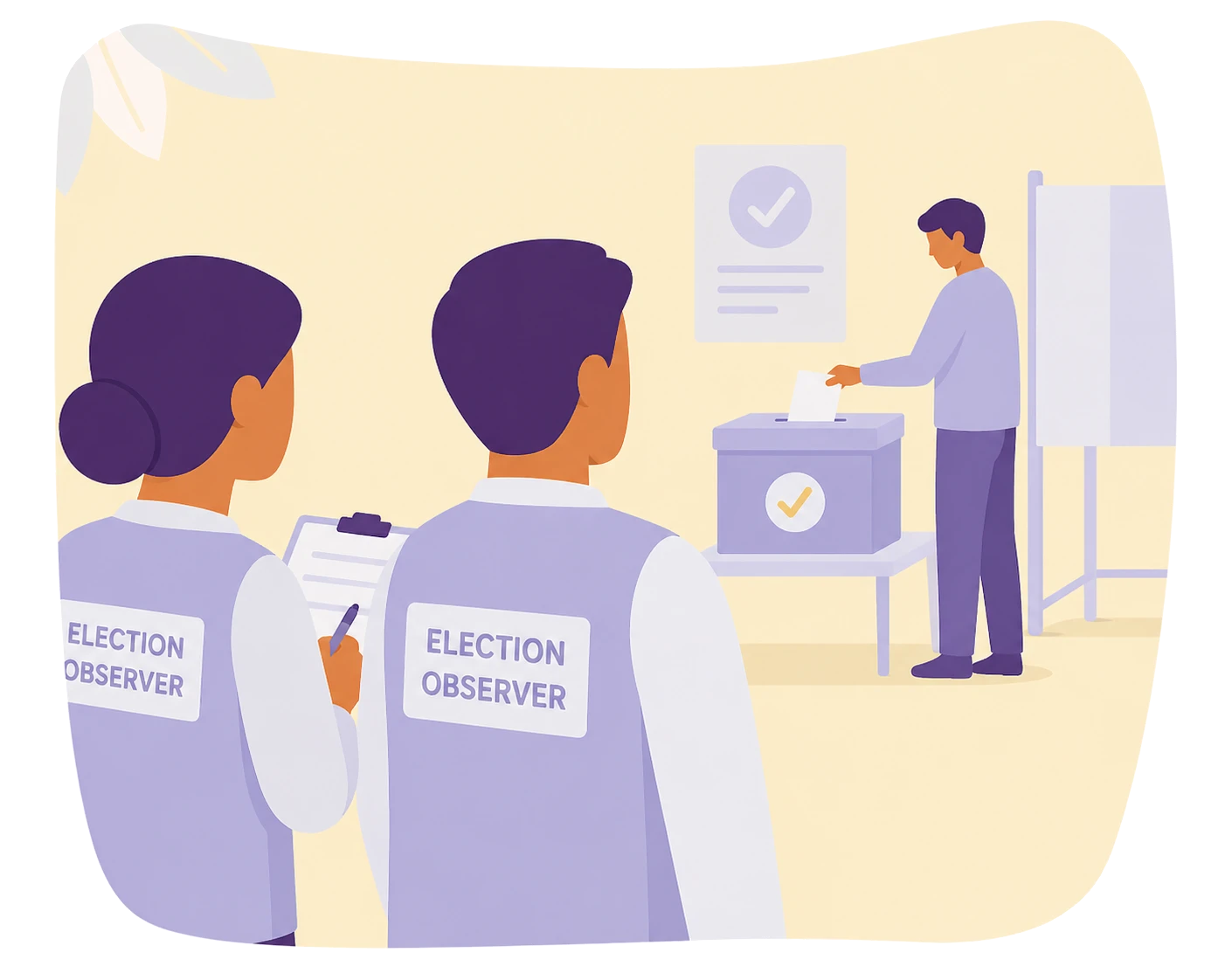
In collaboration with the Free Vote Foundation, we built an end-to-end alternate vote counting system used by the Hungarian opposition and international election observers during the 2026 parliamentary elections.

The system was built on Resarc infrastructure, making data tampering detectable and any post-hoc manipulation mathematically provable. Systems were hardened against intrusion and DDoS attacks operating in a hostile environment.

Election integrity DDoS hardened Tamper-proof
projects elections
DE! Action Community & Hungarian Civil Liberties Union

Election incident reporting across 500+ voting locations

In collaboration with DE! Action Community, we built a secure incident reporting pipeline used by election observers deployed to over 500 voting locations during the 2026 Hungarian elections.

Text, photo, and video evidence was collected in real time and fed into a live broadcast monitored by the Hungarian Civil Liberties Union for potential legal proceedings. The system also powered a real-time observer management dashboard.

500+ locations Real-time broadcast Legal evidence chain
projects elections1
You're almost in.
We've sent a confirmation email to . Complete your sign-up by clicking the link inside.
1
Email submitted
Done. Your address is in our system.
2
Check your inbox
Look for an email from Resarc with the subject Please confirm your subscription.
3
Click the confirmation link
One click and you're confirmed. That's it.
Can't find the email? Check your spam or promotions folder.